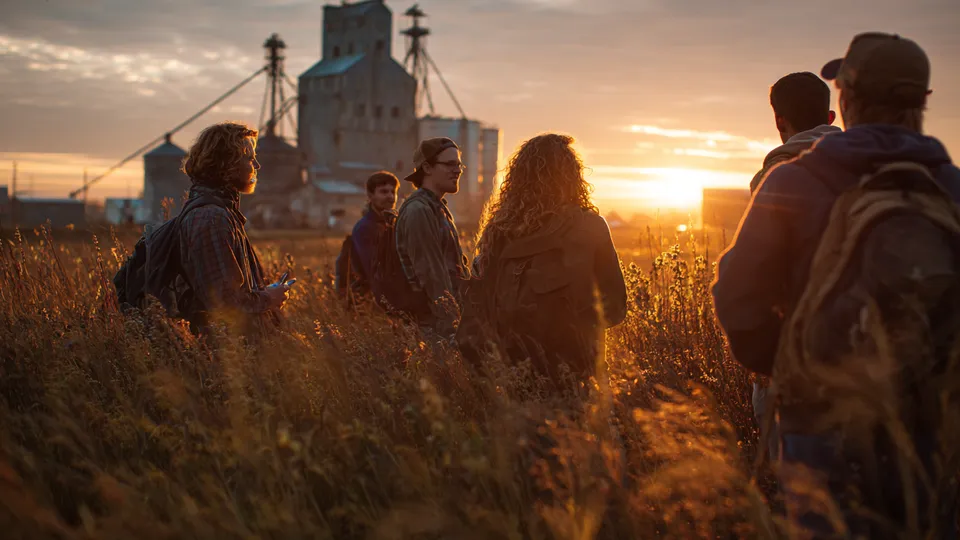
On a damp morning just west of Brandon, Marta LeBlanc kneels at the edge of a freshly dug soil pit and lifts a fistful of loam to her nose. The smell is rich, earthy — not pristine, but hopeful. Marta, 34, grew up on a canola farm near Rapid City and has watched the land go through cycles of booming prices and anxious drought. She is one of the founding members of the Prairie Roots Collective, a initiative that has quietly remade how farmers in Westman test ideas, share data and bring young people into fields they might otherwise leave behind.
The Collective doesn't look like a research institute. It is a converted workshop behind a grain elevator, a pickup truck with a pasteboard sign, a heated storeroom of seed packets and a whiteboard where the next set of trials is drawn in dry-erase blue. What it lacks in bureaucratic polish it makes up for in practical curiosity: cover-crop cocktails tested on half-acre strips, inexpensive moisture sensors cobbled from hobbyist parts, a cooperative seed bank focused on landrace varieties more suited to prairie winters.
Prairie Roots started two years ago after a blunt conversation at a community forum on rural out-migration. Farmers voiced fatigue with one-size-fits-all recommendations from distant agencies. Local technicians, makers and a handful of Brandon University students suggested a different model — a place where farmers design questions, students build tools to answer them, and knowledge stays visible and owned by the community. The first grant was modest; the commitment was not.
One of the Collective's first experiments involved cover crops. Farmers in the region had heard about the benefits of cover crops for erosion control and soil carbon but were wary of the expense and the timing. The Collective tested three cocktail mixes across neighboring farms: a rye-heavy mix, a legume-dominant blend, and a diverse seven-species mix that included turnip and phacelia. Rather than report abstract percentages, they tracked what mattered to local budgets — seed cost, time to establishment, how the mix affected the following year's seeding window.
'We weren't chasing a headline,' Marta says. 'We wanted to know if we could stabilize emergence after a hard rain and maybe cut back on a spring nitrogen application.' The results were granular and practical: the legume mix improved early moisture retention on a heavier clay plot near Rivers, while the rye mix proved more reliable on lighter soils toward Virden. Farmers took those findings across fences and adjusted plans, not because a university paper said so, but because their neighbours had repeated the results on their land.
there is understated. Jonah Peters, a computer science graduate student at Brandon University, built a set of low-cost subsurface moisture sensors using off-the-shelf microcontrollers, a handful of probes and solar-charged batteries. Data flows into a farmer-controlled commons — a simple dashboard where participants choose what to share and which fields remain private. 'Transparency with consent,' Jonah calls it. 'Farmers want usable information, not surveillance.'
Perhaps the most surprising change is not in the data but in who is taking the shovel. The Collective runs a summer apprenticeship program pairing high-school and university students with host farmers. Apprentices attend soil labs, learn to read a root profile, and help maintain the seed bank. They are paid, but many speak of the non-monetary returns: a clearer sense of purpose, a viable path to remain in or return to rural Westman.
'There is a lot of young talent that didn't know it belonged out here,' says Claire Mitchell, who runs the apprenticeship program. 'They build sensors, but they also learn how to listen to neighbours and interpret land in seasonal rhythms.' A former apprentice now manages community plots, and two others started businesses making durable, prairie-suited beekeeping boxes that supplement pollination and farm income.
The Collective's success has been quietly contagious. Neighbouring town councils have funded mobile soil pits for public demonstrations. Agronomists from non-profit groups visit to learn how community-led trials can complement formal research. Importantly, the initiative reframes failure as learning; failed seed mixes and frost-damaged plots become public notes rather than reasons for retreat.
Looking forward, members hope to knit these localized experiments into broader resilience strategies. They imagine a regional network of community labs across Westman that can rapidly test crop responses to weather extremes, share seed adaptations and create collective bargaining power for niche seed and crop markets. They are also pushing for policy changes — predictable small-scale research funding, more support for community data trusts, and apprenticeship credits that count toward agricultural certifications.
There is an economy of care in the Collective's work: time spent measuring roots, sharing a potluck after a long day in the field, a student returning home with the confidence to start an enterprise. Those are hard to quantify, yet they matter in a place where the season's mercy determines winter's budget.
If agricultural in the prairies is often imagined as big machines and large-scale genomic leaps, the work in Westman suggests another path. It is modest, iterative and deeply social — an architecture of small experiments that, together, create options for farms and the people who live on them. The true yield may not be a higher bushel count this year but a community better equipped to adapt, to teach and to steward the land for decades to come.