On a wind-moderated morning in late May, the Riverbank Discovery Centre looked less like a museum and more like a command post. Folding tables bristled with native seedlings, soil probes and volunteer sign-up sheets; a map of the Assiniboine showed fragile bends and recent planting sites marked in bright green; children clustered around a portable water lab, learning to measure turbidity with earnest concentration. The Prairie Resilience Forum, a one-day event organized by a loose coalition of neighbourhood groups, university researchers and municipal staff, had turned a familiar stretch of Brandon into a laboratory of possible futures.
The first thing you noticed was how ordinary the work felt. This was not a conclave of distant experts prescribing grand transitions; it was neighbours trading hard-won techniques—how to trench for a swale, which native sedge survives spring floods, how to coax community members to adopt a backyard composting routine. Yet under that everyday texture sat ambition: to move small, practical experiments into public infrastructure and policy.
At a panel titled 'River, Field, and Roof,' an agronomist from Brandon University set out results from a two-year demonstration on soil carbon. Plots on three area farms had adopted cover cropping and reduced tillage; those practices, she reported, reduced erosion and improved water infiltration enough last year to blunt what would otherwise have been serious runoff during spring melt. The numbers were modest—fractional increases in stored carbon, measurable reductions in nitrate spikes—but the farmers in the room nodded. For them, the point was less about headlines than survivability.
'We don't need miracles,' said Lucas Hiebert, a mixed-grain farmer from west of Brandon. 'We need practices that let us keep farming when the weather refuses to be predictable. Cover crops give us a margin.' His voice carried a practical urgency: changing the land is a long, incremental conversation with weather and markets.
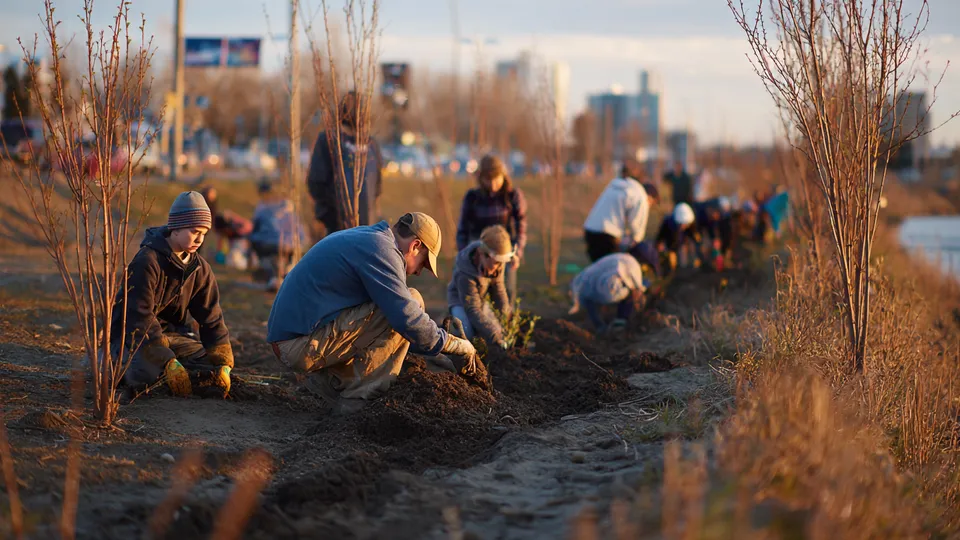
Equally tangible were conversations about the Assiniboine itself. A restoration team demonstrated live willow staking, explaining how root systems stabilize banks and create habitat. Nearby, a youth citizen-science table was logging phosphate concentrations along different river reaches—data that will feed into a public dashboard the city plans to publish this summer. 'Kids learn that the river talks to us,' said Emma Torres, a volunteer coordinator. 'They come back and tell their parents. That ripples.'
The forum also hosted the Westman Community Solar Co-op, where residents could see modeled payback periods for rooftop arrays and sign up for group purchasing. The co-op has already facilitated two modest municipal installations—one on a recreation centre and one on a public works garage—but the co-op's organizers emphasized that the real leverage comes from aggregating demand and creating a local supply chain of installers and maintenance workers.
A quieter thread through the day was story-telling about labour and belonging. A retired schoolteacher described starting a neighbourhood compost pilot that began with five families and now collects food scraps from 60 households. A high school science club demonstrated a vermicompost system that turned cafeteria waste into rich soil for the school's garden beds. These projects are small economies: students, retirees and newcomers trading service hours, seedlings and skills.
Policy conversations threaded in as well. A city councillor, speaking from the floor rather than a podium, argued that municipal budgeting needs to move beyond single-line items for 'parks' or 'infrastructure' and toward integrated resiliency accounts that recognize joint benefits—biodiverse plantings that lower flood premiums and reduce maintenance costs, or rooftop solar that stabilizes municipal energy budgets. 'If we value the long view,' she said, 'we fund things differently.'
There are tensions. Some farmers worry about regulatory burdens; some residents fear changes to familiar landscapes. Funding remains the stubborn constraint—many promising pilots exist on handshakes and volunteer time rather than sustainable revenue. Still, the forum's signature quality was not naivety but a patient, iterative pragmatism. Participants treated failure as data: a planting that washed away suggested a different species, a municipal pilot with tepid uptake pointed to better outreach rather than abandonment.
At dusk, as volunteers hauled banners and the last of the seedlings were boxed for drop-off to community plots, a young participant from the water lab lingered by the river. 'It feels like we can actually do something,' she said, kneeling to examine a willow cutting. Her compact certainty—part curiosity, part heirloom stewardship—was the evening's quiet echo.
What the Prairie Resilience Forum made clear is that climate adaptation in the Westman region will be less about singular technological fixes and more about building durable processes: local data collection feeding city planning, shared purchasing reducing costs, school gardens creating a generation with soil-sense. The real work will be in knitting these threads into budgets, labour agreements and municipal bylaws. If Brandon's experiment is instructive, it is because it shows how many small, human-scale interventions can aggregate into institutional change. That is neither glib nor easy; it is, precisely, a kind of patient politics.
As participants dispersed, maps annotated with new planting sites and contact details exchanged, there was a sense of modest accumulation. The prairie does not promise sudden redemption, but it does reward persistence. The forum's real achievement was not to invent a single solution, but to make visible the community of practice that will keep trying.