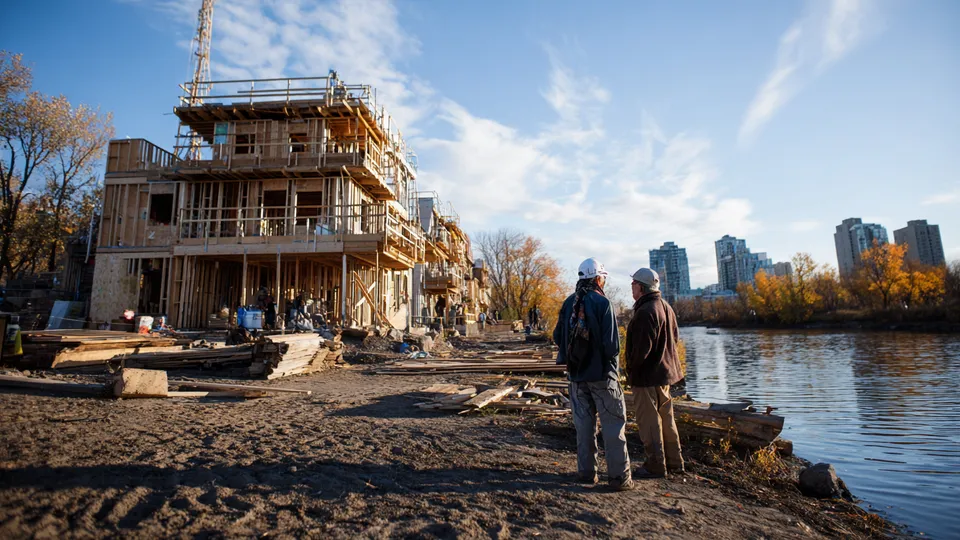
On a wind-thinned morning beside the Assiniboine, a small crew of volunteers cups their hands around hot coffee and watches an excavator cut at clay the colour of prairie dusk. Across from them, a row of townhouses rises from a formerly vacant lot, their timber facades stained in soft ochres meant to echo the grain elevators that once defined Brandon’s skyline. This is not a glossy promotional unveiling but the slow choreography of -making: neighbours, municipal planners, Indigenous Elders, and contractors negotiating the shape of everyday life.
The project—known among participants as the Westman Renewal Collective—did not begin with a single developer’s vision. It began, as many local initiatives do, with a problem and a dinner table. Rising land prices, a shrinking supply of affordable rental housing, and a riverfront scarred by industrial decline met the persistence of a small but determined coalition. They pooled knowledge, skills, and a stubborn sense of possibility: what if development were not merely extraction of value from place, but a public act of repair?
“People wanted to stop watching things happen to them and start deciding what those things should be,” said Jenna Martin, the Collective’s coordinator, as she traced a plan on a folded map. “We learned to ask: who benefits, who keeps living here, and how do we make space for both new opportunity and long memory?”
That question has guided a set of concrete interventions. On one block, a community land trust partnered with the city to convert three derelict lots into 32 units of mixed-income housing—two-bedroom units intended for families, studio apartments for newcomers, and three live-work studios reserved for artists and tradespeople. Nearby, a brownfield remediation program transformed a former warehousing yard into a rain garden and linear park that doubles as flood mitigation. The designs are pragmatic and, in small ways, radical: communal laundry rooms, a tool library, and a maintenance co-op staffed by trainees from a local workforce program.
The human impact is not only material. For residents like Evelyn Cook, a maintenance worker who moved into one of the new units last winter, the change is about breathing room. “Before, my rent kept going up and I didn’t have savings,” she said, balancing a toddler in her arms. “Now there’s a place for him to run and a neighbor who watches him when I work evenings. That’s everything.”
Indigenous participation has been central to the Collective’s approach. Leaders from local First Nations were involved from the outset—helping to shape land-use priorities, interpret the riverbank’s cultural significance, and suggest traditional plantings for the park spaces. “The river is not a problem to be tamed,” said Elder Mary Sinclair in a conversation at the band office. “It’s a relative. When you listen to it, you learn how to live here better.” That ethic translated into design decisions that prioritize seasonal biodiversity and public ceremony spaces, creating a landscape that supports both ecological function and cultural practice.
Funding has been a patchwork: provincial grants for brownfield cleanup, municipal density bonuses, philanthropy from local businesses, and small-dollar community bonds that invited residents to invest. But money alone did not secure trust. The Collective’s early public meetings were fractious—residents suspicious of gentrification, small- owners worried about displacement, long-time homeowners anxious about changing neighbourhood character. The process of deliberation—transparent budgets, rotating leadership, and a binding community benefits agreement—has been as important as the capital stack.
There have been failures and hard lessons. A pilot co-housing design ran over budget and had to be simplified; a proposed grocery co-op stalled when startup capital proved harder to marshal than expected. Yet those setbacks sharpened the Collective’s institutional muscle: they refined procurement rules to favour local contractors, created apprenticeship slots to retain labour dollars within the region, and set aside a contingency fund for unexpected repairs—an idea born of lived experience and of days spent scraping ice off community boilers.
The impact is measurable and intimate. Dozens of households have more stable housing; a stretch of riverbank that was once fenced off is now open to families, anglers, and school groups; and a small apprenticeship program has placed 14 people into trades training with guaranteed work on neighborhood projects. But the deeper effect is cultural: a widening of civic imagination in a region often written off by urban planners as peripheral.
Looking ahead, the Collective is thinking regionally. Conversations are underway with neighbouring towns about replicating the land trust model and sharing stormwater infrastructure for contiguous benefits. Planners are drafting a ten-year stewardship covenant that would bind future development to specific community outcomes—affordability thresholds, public space guarantees, and Indigenous access rights.
That covenant will test the durability of the new civic compact. Yet the renewal already suggests an alternative to the extractive rhythms of growth: a patient, iterative practice of building that names risk, centers relationships, and treats public benefit as infrastructure in its own right. For Westman, the work is not a one-off fix but a modest form of future-making—an insistence that places can be improved without erasing the people who make them meaningful.
As the construction crew finishes for the day, neighbours linger on a bench and watch a heron negotiate the river’s current. Plans and contracts will continue to multiply, and inevitable tradeoffs remain. But for a region that has long been told its destiny is to supply others, this coalition’s quiet insistence—that development can be a shared project—feels like a different kind of map, drawn by people who intend to stay.