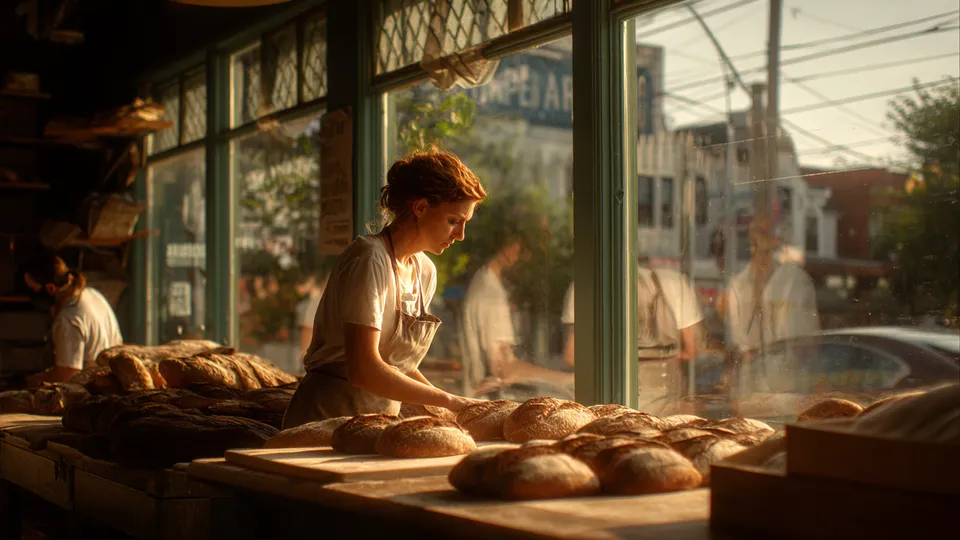
In the pale light before the city lifts its shutters, the oven in Bridge & Loaf begins its slow, precise work. Flour dusts the air like river spray; loaves expand with a sound that is at once mechanical and intimate. The bakery sits on a narrow block of Brandon’s downtown, its plate-glass window a stage for a craft that has quietly become civic infrastructure.
Amina Hassan, the bakery's founder, moves through that morning bustle with an economy of motion—measuring, tasting, teaching. She is not simply producing bread. Over the last five years she has stitched together a web of apprenticeships, farm partnerships, subsidized meal programs, and neighborhood deliveries that has shifted how this part of Westman thinks about small business.
"I wanted more than a place that sells pastries," she says, wiping her hands on her apron. "I wanted to build a place that teaches people how to be in the economy—how to make, how to keep neat accounts, how to show up. The bread is the work, but the training is the product."
Amina's path to was not linear. She studied culinary arts at Assiniboine College, worked in Winnipeg and Calgary, then returned to Brandon with the conviction that rural economies needed businesses that could do two things at once: make a living and make workers.
Bridge & Loaf now employs 18 people, half of them young trainees from Brandon's high schools and adult-education programs. The bakery offers a three-month paid apprenticeship that pairs on-the-job mentorship with financial literacy workshops taught in collaboration with a downtown credit union. Since opening, the program has placed 12 trainees into permanent positions—seven within the bakery and five with bakeries, restaurants, and a seasonally expanding farmers' market operation across Westman.
"I came here not knowing how to speak to employers," says Jared Thompson, 19, who apprenticed last winter. "Amina taught me how to read a purchase order, how to deal with suppliers, how to handle pressure. Now I make dough confidently, and I can see a future where I manage my own shift."
What makes Bridge & Loaf unusual is not just the training pipeline but the way Amina rebuilt a local supply chain around regenerative grain. She sources flour from three nearby growers—small-plot mixed farms near Minnedosa and Rivers that had been struggling to find steady markets for specialty heritage wheat. Bridge & Loaf agrees to minimum annual purchases, paying a modest premium to encourage crop diversity and soil-restorative practices.
The economic ripple is measurable. Farmers report steadier cash flows and fewer surplus bins at harvest. The bakery’s wholesale accounts—cafés, a hospital cafeteria, and a handful of grocery co-ops across Westman—create demand that makes diversified cropping more viable.
"We stopped growing just for the grain elevator," says Rowan Gilmour, a farmer who pivoted to hull-less barley and heritage wheat after Bridge & Loaf began buying. "Having someone local who values how we farm changes planning. It's not a big cheque, but it's steady work and it lets us think long term."
Amina also runs a sliding-scale meal program that supplies 150 subsidized loaves and prepared meals each month to seniors and families in need. Those meals are coordinated with a regional health outreach team that recognized food stability as a determinant of health.
The bakery’s presence has helped anchor a small revival of the block. A vacant storefront became a bike repair shop. A community art collective uses Bridge & Loaf’s back room once a week for craft nights. The bakery's early-morning delivery routes bring bread to a retirement home, a school, and a shelter—each stop reading like a map of social connectivity.
"This is how resilience gets built," says Dr. Leanne Brousseau, a social geographer at Brandon University who studies rural economies. "It’s not a single heroic startup that scales globally. It’s these micro-ecologies where risk and reward are shared among farms, workers, and civic institutions."
Scaling in a place like Brandon is not simply a matter of opening another outlet. For Amina, any growth must preserve the training model and the farm partnerships that differentiate Bridge & Loaf. She is exploring a co-op milling operation with other bakers in Westman to reduce costs and keep more value local. She is also piloting a mobile oven—an adapted trailer that can take baking workshops and doughnuts to smaller towns with limited culinary infrastructure.
"I’m cautious about growth," Amina says. "If we expand, it has to be on terms that keep the apprenticeships and farmers at the center. Otherwise we become just another brand."
The bakery's footprint is small—a single storefront, a tight team, a handful of farmers—but its approach is instructive. In an era where rural communities are often measured by what they lose, Bridge & Loaf offers a subtler metric: the circuits of exchange that can be recovered when entrepreneurship is deliberately anchored to place.
That anchoring requires patience and compromise, a willingness to accept modest margins in exchange for stability and training. It also requires a different kind of ambition—not growth at all costs, but scaling in service of relationships.
When the oven door opens and bread is slid out in the soft light, the work feels elemental. But behind every loaf there is a ledger: of labor hours, of farmer payments, of a young person graduates from apprentice to paid staff. It is in that arithmetic—simple, steadfast—that the real story of rural entrepreneurship in Westman is written.
"People ask me when I will franchise," Amina says with a brief laugh. "My answer is: when we can make sure every new location does the same work we do here—not just selling bread, but teaching hands how to make it."
That patience, and that commitment to making skills portable across the region, is the quiet infrastructure of a different kind of prosperity. In Brandon, it smells like yeast and possibility.